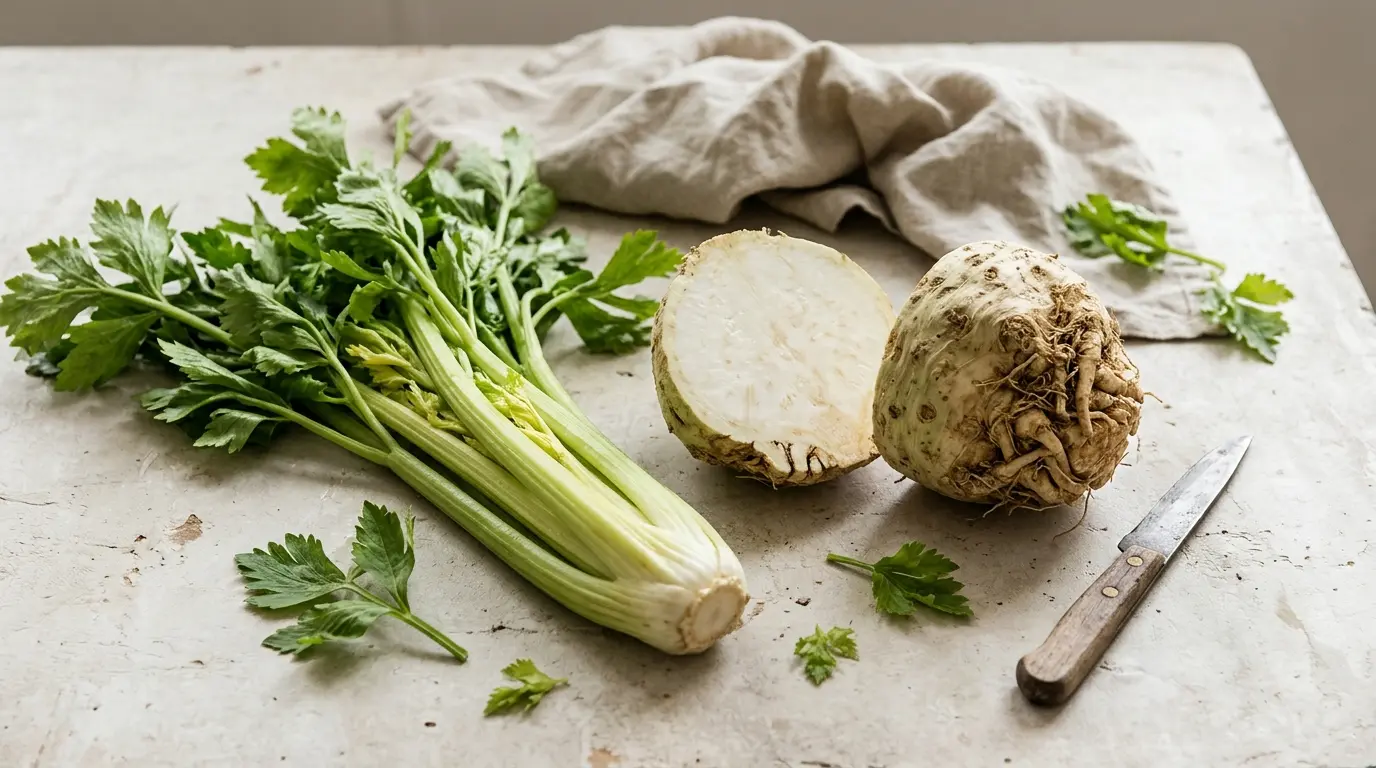
I was chopping vegetables for dinner one evening when I noticed how easily celery becomes an afterthought in everyday cooking. A few stalks go into a soup or salad, while the leaves and root often receive much less attention.
That made me curious about the phrase pravi celer, which translates roughly as “real celery” or “true celery” in South Slavic languages.
The expression does not refer to a separate botanical species. It offers an interesting starting point for exploring celery itself, including its different cultivated forms, nutritional qualities, and traditional uses in Balkan cooking.
From crisp green stalks to earthy celeriac root, there is more to this familiar vegetable than its usual place in the kitchen suggests.
What Pravi Celer Actually Means
In Serbian, Croatian, and Bosnian, the words pravi celer can be understood as “true celery” or “real celery.” The expression describes celery rather than identifying a separate botanical variety. The word pravi means true, genuine, or real, while celer refers to celery.
It is important to understand that pravi celer is not a separate scientifically recognised species or a separate or special variety of celery. Rather, it is a descriptive expression associated with traditional celery and its use in food culture.
Celery belongs to the botanical species Apium graveolens, which has several cultivated forms.
The familiar green celery is grown mainly for its crisp stalks. Celeriac, sometimes called celery root, is cultivated for its swollen edible base. Leaf celery is valued for its aromatic foliage.
These varieties share a botanical relationship, but their appearance, flavour, and culinary purposes are different.
A Plant With a Surprisingly Long History
Celery has travelled through kitchens and cultures for centuries.
Its Mediterranean origins helped establish it as a familiar aromatic plant in European food traditions. Over time, different varieties became popular in different regions of Europe.
In Balkan cooking, celery has an important place in soups, broths, vegetable dishes, and meat-based recipes. Celeriac is especially useful because its root brings a deeper, earthier flavour than ordinary celery stalks.
There is something practical about this traditional approach. Rather than treating celery as a small supporting ingredient, cooks use it to build the flavour of an entire dish.
The leaves can provide seasoning, the stalks add texture, and the root can give soups and stews a fuller taste.
This approach is not about discovering a miraculous new food. It is about understanding an ingredient that has been part of everyday cooking for generations.
What Makes Celery Nutritionally Interesting?
The health value of pravi celer comes from the nutritional qualities of the celery plant rather than from the name itself.
Celery contains water, dietary fibre, vitamins, minerals, and naturally occurring plant compounds. Its exact nutritional composition depends on the variety and which part is eaten.
A few nutritional components are particularly worth understanding.
Vitamin K: Celery provides vitamin K, a nutrient involved in normal blood clotting and bone metabolism. It contributes to the body’s everyday nutritional requirements.
Vitamin C: This vitamin supports normal immune function, collagen formation, and protection of cells from oxidative stress.
Potassium: Potassium is an essential mineral involved in normal muscle function, nerve signalling, and the regulation of blood pressure.
Dietary Fibre: Fibre supports digestive health and helps maintain regular bowel movements. Root celery can be particularly useful as part of a varied vegetable intake.
Plant Compounds: Celery contains naturally occurring compounds, including flavonoids such as apigenin and luteolin. Researchers have investigated these substances for their antioxidant and other biological properties.
The important distinction is that the presence of these compounds does not automatically mean celery can prevent or treat a disease. It is a nutritious vegetable, not a replacement for medical treatment.
How Celery Supports Everyday Health
I find it more useful to look at celery through the small contributions it makes to a balanced diet rather than expecting one vegetable to transform someone’s health.
Its nutritional profile offers several practical benefits.
Supporting Digestive Health
Celery contains dietary fibre, which helps support regular bowel movements. Including it alongside other vegetables, fruits, whole grains, and legumes can contribute to a balanced, fibre-rich diet.
Its water content also makes it a refreshing addition to meals.
However, celery alone is not a treatment for constipation or other digestive conditions. The overall quality of the diet matters much more.
Contributing to Heart Health
Potassium is one of the minerals that makes celery nutritionally valuable.
Adequate potassium intake supports normal blood pressure regulation, while a diet rich in vegetables is generally associated with better cardiovascular health.
Celery can contribute to that dietary pattern, especially when used in place of heavily salted or highly processed ingredients.
It is not a blood pressure medication, and eating celery does not guarantee protection against heart disease.
Supporting Bone Health
Celery provides vitamin K, a nutrient involved in normal bone metabolism. Other foods, including leafy greens, beans, dairy products, and fortified alternatives, can also contribute nutrients that support healthy bones.
Providing Antioxidant Compounds
Plants naturally produce compounds that help protect them against environmental stress.
Celery contains several phytochemicals, including flavonoids and phenolic compounds, that have attracted scientific interest because of their antioxidant activity.
These compounds are interesting from a nutritional research perspective, but laboratory findings should not be confused with proven health benefits in humans.
Eating a variety of colourful vegetables remains a more sensible approach than relying on one particular plant.
Adding Hydration Through Food
Celery has a high water content, which makes it a refreshing vegetable to eat raw or cooked.
Water-rich foods contribute to overall fluid intake, although drinking enough water throughout the day remains important.
For someone looking for a light snack, celery sticks can be a simple alternative to salty packaged snacks.
What Each Part of the Celery Plant Offers
One detail I find particularly interesting about celery is how differently its parts can be used.
The stalk is probably the most familiar, but it is not the only useful part.
Celery stalks
These are crisp, mildly flavoured, and suitable for salads, soups, sandwiches, and snacks. They provide water, fibre, and various micronutrients.
Celery leaves
The leaves have a stronger flavour than the stalks. They work well as a fresh herb in soups, sauces, salads, and vegetable dishes.
Celeriac root
Celeriac has a firm, pale interior and a flavour that combines mild celery notes with earthy characteristics. It can be roasted, mashed, boiled, or grated into salads.
Celery seeds
Celery seeds are used as a seasoning in certain cuisines. Their concentrated flavour makes them useful in spice blends, pickling mixtures, and savoury dishes.
Using different parts of the plant adds variety to cooking and can help reduce unnecessary food waste.
How to Include Pravi Celer in Everyday Meals
Celery does not require complicated preparation. In fact, some of its best uses are surprisingly simple.
I particularly like the idea of adding it to dishes where its natural aroma can develop slowly.
Here are a few practical ways to use it.
1. Fresh Celery Salad
Slice celery stalks thinly and combine them with cucumber, apple, lemon juice, olive oil, and a little black pepper. The result is a fresh salad with a pleasant crunch.
2. Traditional Vegetable Soup
Add chopped celery, carrots, onions, and other vegetables to a pot of vegetable stock. Allow everything to simmer until tender. The celery helps build a savoury base.
3. Roasted Celeriac
Peel and cut celeriac into small cubes. Toss with olive oil, black pepper, and herbs, then roast until the edges become golden and tender.
4. Celery and Potato Mash
Boil celeriac with potatoes and mash them together with a little olive oil or butter. This creates a slightly earthy alternative to ordinary mashed potatoes.
5. Fresh Celery Juice
Celery can be blended or juiced for a refreshing drink. However, whole celery retains more of its original fibre than strained juice, so it should not be treated as a superior health remedy.
The best approach is to use celery in ways that make meals enjoyable and nutritionally varied.
Choosing and Storing Good-Quality Celery
The quality of celery makes a noticeable difference to its flavour and texture.
When buying stalk celery, look for firm stalks with fresh-looking leaves. Avoid bunches that appear excessively limp, yellowed, or damaged.
For celeriac, choose a root that feels firm and heavy for its size. Its rough exterior is completely normal, but avoid roots with soft, wet, or badly damaged areas.
Once home, refrigerate fresh celery to help preserve its crispness. Keep it protected from excessive moisture loss, and remove damaged leaves or stalks before storage.
Celeriac should also be refrigerated. Once cut, its exposed flesh can discolour, so a little lemon juice can help maintain its appearance.
Freshness matters, but there is no need to assume that an imperfect-looking vegetable has lost all its nutritional value.
Are There Any Precautions to Consider?
Celery is commonly eaten and tolerated by most people, but there are a few things worth remembering.
Some individuals have celery allergies, which can occasionally cause serious allergic reactions. Anyone with a known celery allergy should avoid it.
People taking warfarin or similar vitamin K-sensitive anticoagulant medication should maintain a consistent intake of vitamin K-containing foods and follow their healthcare professional’s advice.
Another important point concerns celery juice and detox claims. There is no reliable evidence that drinking celery juice removes toxins from the body or cures chronic diseases. The liver and kidneys already perform essential waste-processing functions.
Celery is best appreciated as part of a balanced eating pattern rather than as a miracle ingredient.
Conclusion
There is something interesting about ingredients that rarely attract much attention. Celery is familiar enough to become part of everyday cooking, yet its different forms offer more variety than a bunch of green stalks might suggest.
The root can bring depth to a soup, the leaves can add freshness to a meal, and the seeds provide a distinctive seasoning. Each part has its own place in the kitchen.
Pravi celer is not a special superfood or a separate botanical discovery. It is a useful way to explore an ordinary vegetable through its language, culinary history, and everyday uses.
Sometimes getting more out of an ingredient simply starts with looking at it a little differently.